

Why Private Label Data Cables Are Worth the Effort
For distributors, e-commerce brands, and retail buyers, a private-label program turns a commodity USB-C or Lightning cable into a product that carries your name, your packaging, and your quality promise. Several 2026 sourcing reports note that buyers who move from generic “white-label” stock to a true private-label build typically capture 18–22% higher end-user pricing, because the product is differentiated rather than interchangeable. The trade-off is real: private label asks for a clearer specification, a longer lead time, and a more disciplined sampling process. This guide walks that process end to end — from the first sample on your desk to a sealed container at the port.

White Label vs. Private Label: Know the Difference
Before you brief a factory, decide which model fits the stage of your business. The two are often confused:
| Factor | White Label | Private Label (HWD focus) |
|---|---|---|
| What you get | A finished, generic cable with your logo added | Customized design, materials, jacket, connectors, and packaging built to your spec |
| Typical MOQ | ~500–1,000 units | From 1,000 units, scalable as volume grows |
| Lead time | Short (weeks) | Longer (includes sampling and tooling) |
| Brand control | Low | High — the product is yours |
| Best for | Market testing, fast restock | Building brand equity and margin |
Industry cost benchmarks published in 2026 put private-label unit economics within reach once volume climbs: the per-unit gap versus white label narrows sharply above 5,000 units. The practical takeaway is to start small, validate demand, then scale the same specification. At a Dongguan factory like HWD, the same production line can serve both a 1,000-unit pilot and a 20-foot container order.
Step 1 — Write a Real Specification Sheet
Do not start with “send me a USB-C cable.” Write down exactly what you want. A usable spec sheet for a data cable should cover:
- Connector combination: USB-C to USB-C, USB-C to Lightning, USB-A to USB-C, or multi-connector.
- Current and power rating: 60W, 100W, or 240W EPR. If 60W/100W, confirm whether an E-Marker chip is required.
- Data rate: USB 2.0 (480 Mbps), USB 3.0/3.1 (5–10 Gbps), or higher.
- Jacket material: PVC, TPE, or braided nylon — each affects flex life and price.
- Length: 0.5m, 1m, 1.5m, 2m, or custom.
- Color, logo, and packaging: neutral bag, color box, hang card, or marketplace-ready carton.
The clearer the sheet, the fewer surprises later. Many 2026 buyer guides stress that a written spec — not a vague description — is the only real quality standard you can hold a factory to.
Step 2 — Approve a Pre-Production Sample
Ask for a pre-production sample built from the proposed configuration, not a polished “demo” unit. Test it the way your customers will use it:
- Charging test: verify current stability and voltage drop at your agreed load and cable length.
- Data transfer test: confirm sync works if the cable claims it.
- Connector inspection: check for loose fit, scratches, or poor plating.
- Bend and pull test: daily-use stress reduces return rates downstream.
Keep one approved “golden sample” sealed and dated. Every pre-shipment batch should be compared against it. Buyer-side sourcing editors in 2026 repeatedly warn that testing a single showpiece unit is not enough — test several from the actual production setup, including each color and connector variant in your order.

Step 3 — Lock the Bulk Production and QC Plan
Once the sample is signed off, translate the spec into the purchase order with explicit test methods and acceptance limits. Agree in advance how problems — unstable charging, excess voltage drop, poor fit, cosmetic mismatch — will be classified and corrected. At HWD, every data cable passes 100% electrical testing before it leaves the line, and a pre-shipment inspection checks charging, data function, connector fit, bend area, jacket finish, printing, and retail packaging.
Step 4 — From Carton to Container
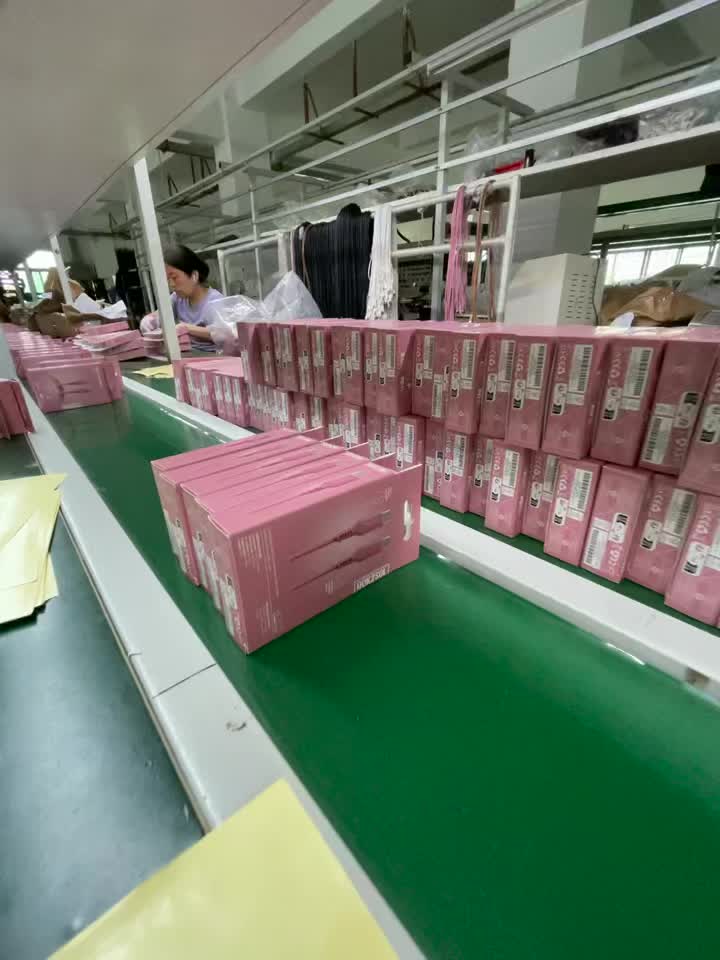
With QC passed, production is packed, carton-counted, and palletized. Confirm Incoterms (FOB is common for Dongguan/Shenzhen shipments), booking, and export documents. A stable specification plus retained samples makes repeat orders simple: compare the same checkpoints lot by lot, and the factory’s performance becomes measurable instead of a gamble.
Compliance and a Note on the Charger
For EU and North American retail, plan for CE, FCC, and RoHS as baseline. If your cable targets Apple-ecosystem devices, ask your factory about MFi program requirements early — it changes connector sourcing and timelines. HWD’s data cables are built to these compliance expectations; the same Dongguan line also supplies HWD-branded chargers as a companion product, so a private-label cable program can be matched with HWD power adapters from one supplier for a cleaner, consistent offering.
Key Takeaways for a Smooth Program
- Start with a written spec sheet — it is your only enforceable quality standard.
- Approve a real pre-production sample and keep a sealed golden reference.
- Move from white label to private label as volume justifies the tooling.
- Require 100% functional testing and a documented pre-shipment inspection.
- Pair HWD data cables with HWD brand chargers from the same factory when a complete kit makes sense.
A private-label data cable program is less about finding the cheapest unit and more about controlling the product from sample to container. Get the spec and the sample right, and the container takes care of itself.