

The $0.50 Saving That Costs You 20%
Every procurement manager has seen the temptation: a quotation comes in at $0.20–$0.50 below the next supplier, and the spreadsheet looks like a win. In the world of data cables, that win is usually an illusion. The unit price is only the tip of the iceberg. Beneath it sit returns, reverse logistics, chargebacks, customs holds, and the slow bleed of a damaged brand name. For B2B buyers—distributors, OEM project leads, and private-label importers—the real metric is not purchase price. It is Total Cost of Ownership (TCO).
A bulk-cable sourcing guide published in 2026 framed this neatly as the “Cost Iceberg.” The visible costs are easy: bill of materials, freight, and import duty. The hidden costs are what destroy margin—defect-driven RMAs, delayed shipments, and non-compliant batches seized at the border. A cable that looks 5% cheaper on paper but produces a 5% defect rate can erase every dollar saved on the order and then some.

What the Failure Data Actually Shows
Quality tiers are not marketing fluff; they show up in hard numbers. Independent lab testing published in 2026 reports that charging and data-cable failure rates run from roughly 8% to 25% within the first year, depending almost entirely on the quality tier. A repair-retail study comparing generic versus certified accessories found cheap lines returned at 15%–30% while certified lines stayed under 5%—and the cheap cables frequently failed safety tests outright.
Put the two tiers side by side and the economics flip:
| Metric | Cheap / Unbranded Tier | Certified / Commercial Tier |
|---|---|---|
| Typical first-year failure | 8%–25% | < 5% |
| Return / warranty rate | 15%–30% | Under 5% |
| Usable lifespan | 3–6 months | 2+ years |
| Conductor material | CCA / CCS (higher resistance) | OFC copper, tin-plated |
| Cost per year (per cable) | Higher (replacements + returns) | Lower (one purchase) |
A Chinese procurement cost study modeled this at scale: a white-label cable quoted at roughly $0.30/unit but carrying a ~15% repair rate produced a higher total cost over 100,000 units than a pure-copper cable at $0.45/unit with a 1% repair rate. The cheaper unit price was a trap.
Three Failure Modes That Trigger Returns
Understanding why cheap cables fail helps buyers write better specifications. Three mechanisms dominate:
- Connector fracture at the strain point. The junction between the connector and the cable body is the most common return trigger—estimated at around 60% of cable returns. Rigid PVC molding concentrates bending force on a 2–3 mm zone. Quality builds use graduated TPE strain relief spread across 20–25 mm, cutting per-millimeter stress roughly 8–10×.
- Conductor degradation from CCA / CCS. Copper-clad aluminum and copper-clad steel have 40%–60% higher resistivity than oxygen-free copper. Under repeated flexing they delaminate and create micro-fractures, so a cable that looks fine charges slowly or intermittently. In high-wattage PD cables, thin conductors also generate heat—a 2026 technology-outlet warning linked poor-quality USB-C cables to short circuits and fires.
- Protocol negotiation failure. Modern fast-charging (PD 3.1, PPS) needs an E-Marker chip that tells the charger the cable’s real capacity. A cable without a valid E-Marker—or with a spoofed one—silently defaults to 7.5 W even when plugged into a 140 W charger. The end user blames the charger, not the cable.
The Reputation Spillover
A returned cable is not just a line-item loss. It is a one-star review, a chargeback dispute, and a buyer who tells three colleagues. Aggregate reputation data from 2026 shows that 75.1% of consumer-electronics companies still rate four stars or higher—but the margin for error on unbranded hardware is shrinking fast. When a distributor’s own logo is on the box, every failure is attributed to them, not the factory.
This is why brand-name importers and OEMs increasingly treat cable quality as a brand-asset decision, not a commodity purchase. The cheapest cable is often the most expensive one you ever bought once you add labor, device-interruption risk, and replacement cost.
How B2B Buyers Protect Their Margin
The good news: the cost iceberg is predictable, and it is avoidable with a few procurement controls:
- Golden-sample lock. Approve a sealed reference sample, then require every mass-production batch to match it—down to wire gauge and E-Marker chip. Some suppliers formalize this as a “BOM-lock” guarantee to prevent bait-and-switch.
- 100% electrical testing. Full end-of-line testing catches open circuits, mislabeled wattage, and dead E-Markers before they reach your customer. Sampling alone leaves the defect rate in your returns queue.
- Certifications that travel. For cross-border sales, CE, FCC, and RoHS documentation smooth customs and reassure buyers. If your SKU targets Apple-ecosystem devices, confirm MFi compliance with the supplier—treat it as a buyer-side checklist item, not an assumption.
- Track returns by SKU and supplier. A simple log of warranty returns exposes which lines actually cost you money within three months.
Where HWD Fits as Your Cable Partner
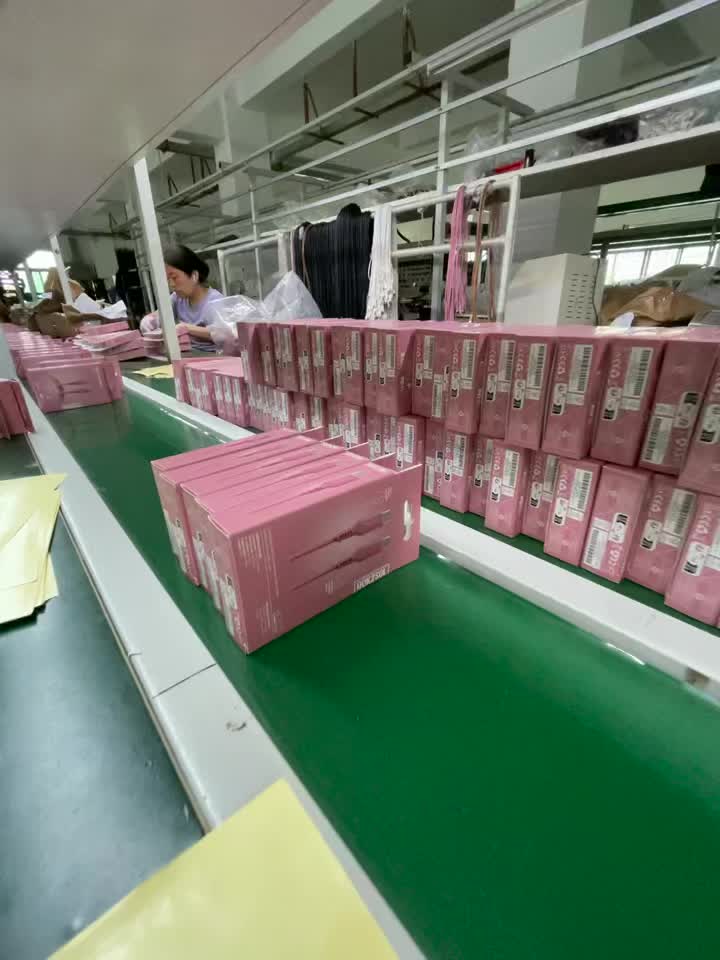
HWD (Huiwenda) is a Dongguan factory focused on custom data cables—USB-C, Lightning, Micro-USB, braided, TPE/PVC jackets, and E-Marker-equipped 60 W / 100 W lines. Our model is built around the margin-protection steps above: in-house tooling and welding, 100% electrical testing on finished cables, and CE / FCC / RoHS documentation for export. We support OEM / ODM with custom connectors, lengths, jackets, colors, and logo, and we keep MOQs low so importers can validate a golden sample before scaling.
For buyers who want a complete desk or travel kit, HWD also supplies HWD-branded chargers as a companion line—matched to our cables so the E-Marker and the power source negotiate correctly. The cable remains the hero; the charger simply rounds out the bundle.
A Practical Sourcing Checklist
- Request the BOM and confirm OFC (not CCA/CCS) conductors for any PD-rated cable.
- Ask for the strain-relief design and a bend-cycle test number (quality tiers target 10,000+ cycles).
- Verify the E-Marker is present and correctly programmed for the rated wattage.
- Require 100% testing plus a sealed golden sample for reorders.
- Collect CE / FCC / RoHS paperwork; add MFi to the checklist for Lightning SKUs.
Cheap and quality are not the same purchase. Spend the extra $0.20 on the cable, and you buy fewer returns, a cleaner reputation, and a lower true cost per unit. That is the math every serious B2B buyer should run before the next quotation lands.